Payday Loans Explained: How the Costs Add Up
Source check: 27 July 2026. Product availability, permitted fees, and rollover rules vary by jurisdiction and lender.
A payday loan is short-term credit commonly tied to the borrower’s next payday. The Consumer Financial Protection Bureau says fees can range from $10 to $30 for each $100 borrowed, with $15 per $100 common; it also explains that payday loans are commonly due in two to four weeks. See the CFPB’s current payday-loan cost guide.
Those figures describe a product category, not a quote for a particular loan. The contract and legally required disclosures control.
Why the fee can be misleading by itself
The fee is a dollar amount. APR is an annualized percentage designed to make credit costs easier to compare. A short loan can therefore have a very high APR even when the fee looks modest.
CFPB example
The CFPB gives this example:
- amount borrowed: $100
- fee: $15
- term: two weeks
- resulting APR: almost 400%
This is an official educational example, not an estimate of every payday product. Read it in context on the CFPB’s cost-and-fee page.
For a specific loan, use the APR and finance charge shown in the lender’s disclosure rather than recreating the calculation from an incomplete advertisement.
Renewal or rollover can add cost
Where renewal or rollover is permitted, a borrower may pay another fee to extend the due date without reducing the original principal by the same amount. The CFPB warns that this can make a short-term loan difficult to repay.
Not every state permits the same product or renewal structure. Do not assume that an example from another state describes the available loan.
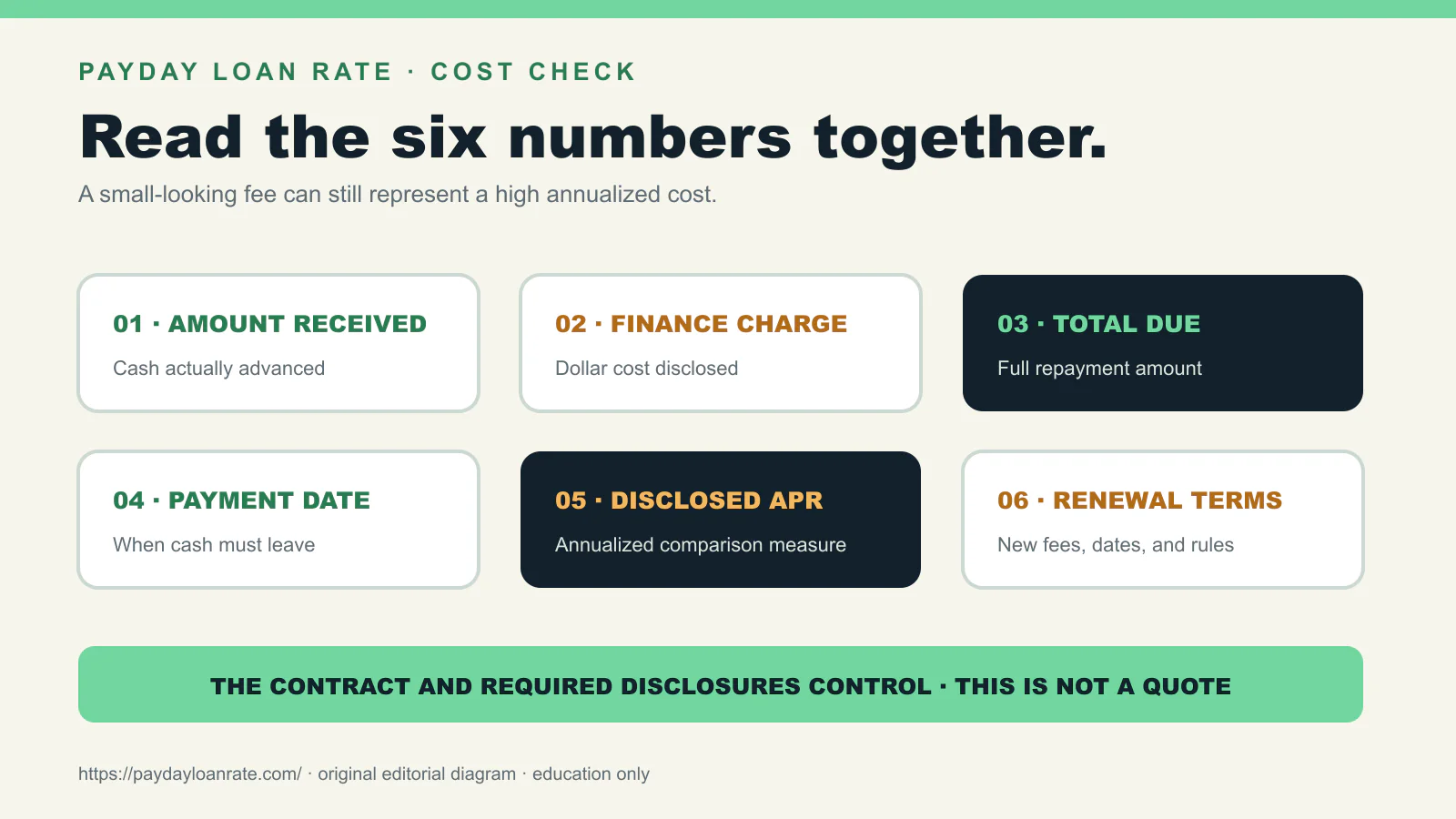
Read six numbers before signing
Record these items from the actual disclosure:
| Item | Question |
|---|---|
| Amount financed | How much credit is being provided? |
| Cash received | How much reaches the borrower after any deductions? |
| Finance charge | What is the dollar cost of credit? |
| APR | What annualized rate is disclosed? |
| Total due | What exact amount must be paid? |
| Due date and schedule | When is each payment required? |
The CFPB’s Regulation Z resource contains the current federal Truth in Lending regulation and official interpretations. Which charges enter a particular disclosure is a legal calculation; do not substitute a marketing headline for the disclosure.
Test the payment against cash flow
Before borrowing, place the full payment on the date it is due and subtract essential expenses due before the next income arrives. If the payment creates another shortfall, the initial loan may not solve the underlying timing problem.
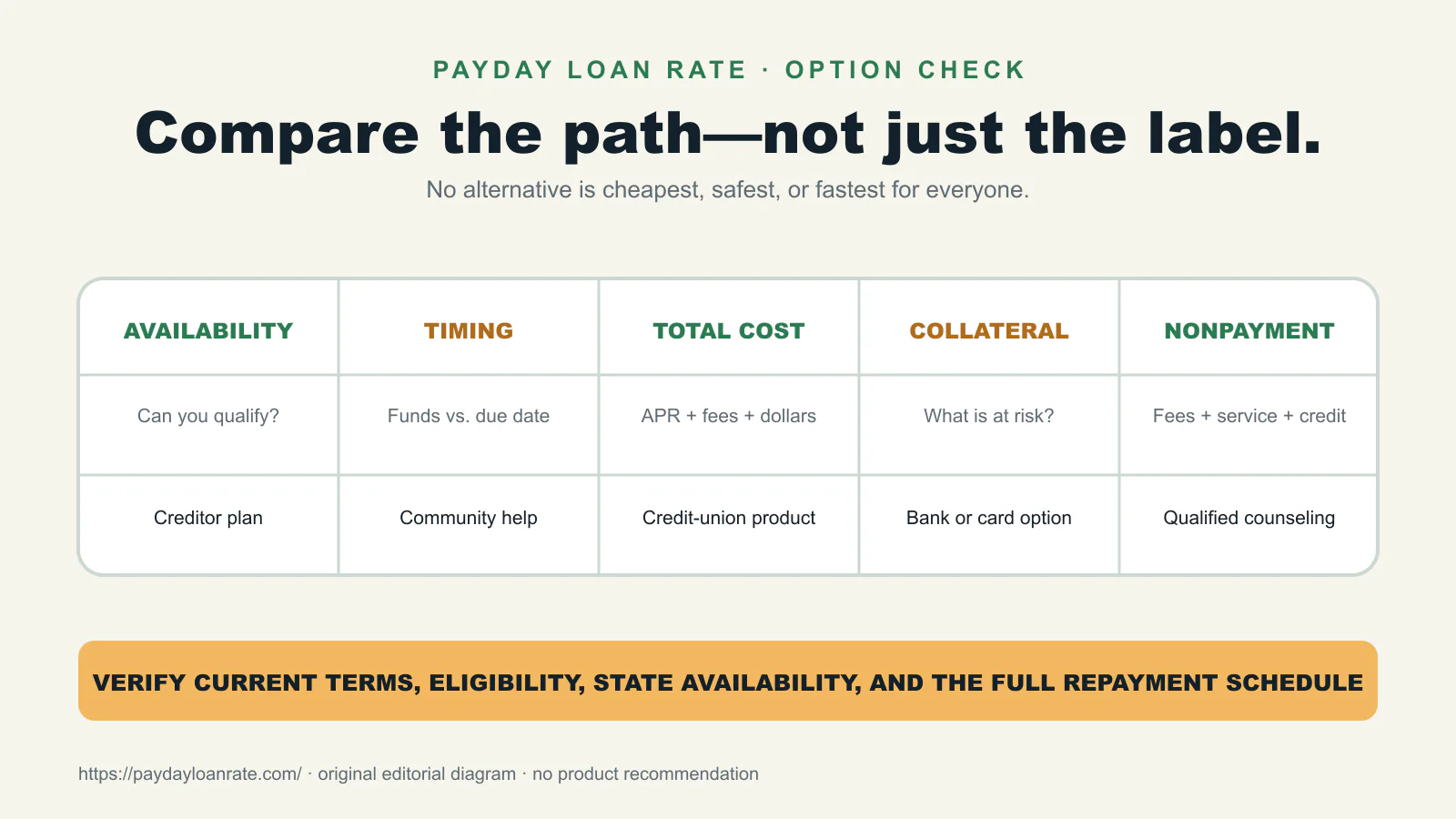
The CFPB’s guide to alternatives suggests comparing creditor payment plans, employer or community options, credit-union products, and other available sources before choosing a payday loan.
Questions to ask the lender
- What is the APR and finance charge?
- What exact amount will I receive and repay?
- Can the loan renew or roll over?
- What happens after a missed or returned payment?
- Is electronic withdrawal authorization optional or revocable under the agreement?
- Which regulator licenses or supervises this lender?
Get answers in the contract and disclosures, not only in a conversation.
Key takeaway
The relevant cost is not merely the fee per $100. Compare the APR, dollar finance charge, cash received, total due, timing, and renewal terms for the specific legally available loan.
General consumer education only, not financial or legal advice and not a loan offer.
payday-loansshort-term-creditloan-feesaprconsumer-education