Options to Compare Before High-Cost Short-Term Borrowing
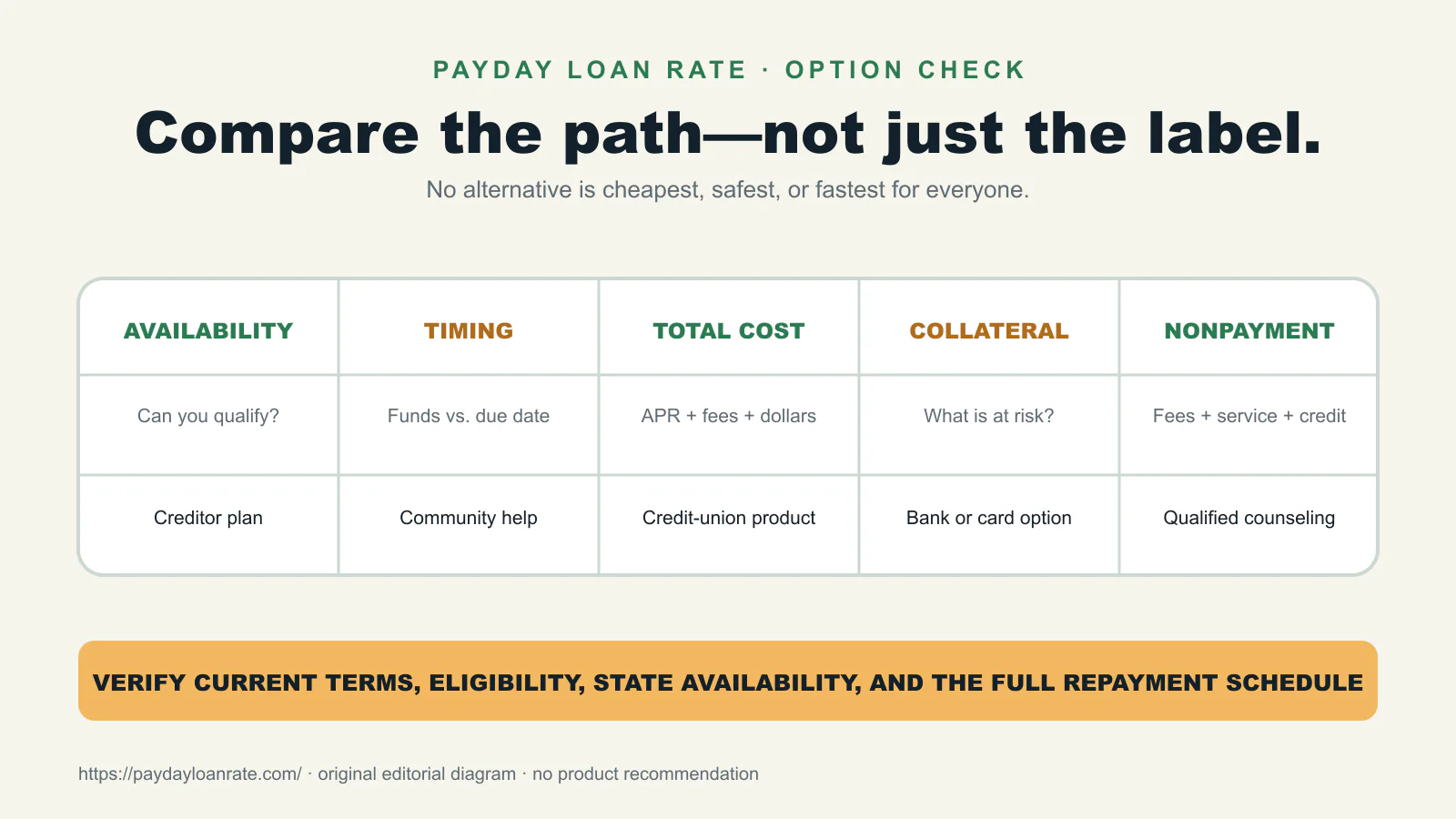
Image: Payday Loan Rate
Source check: 27 July 2026. Eligibility, product terms, and state availability vary.
The CFPB recommends considering alternatives before using a payday loan, including asking creditors for more time, seeking help from family or community organizations, and checking options from banks or credit unions. Review the agency’s current payday-loan alternatives.
This page does not rank one option as universally cheapest, safest, or fastest.
Ask whether the bill can move
Contact the creditor, landlord, utility, medical provider, or service provider before the due date and ask:
- whether the date can be changed;
- whether a documented payment plan exists;
- what fees or service consequences apply;
- whether the agreement will be reported to a credit bureau;
- how the arrangement will be confirmed in writing.
A payment plan can still have cost or consequences. Obtain the actual terms.
Check a credit union
Federal credit unions may offer small-dollar products, including NCUA-authorized Payday Alternative Loans. The NCUA’s PALs II final rule explains the federal framework. A particular credit union decides whether to offer a product and whether an applicant qualifies.
Compare membership requirements, fees, APR, amount, term, underwriting, and funding time. Do not assume every credit-union loan is a PAL or has the same terms.
Compare bank, card, and other credit carefully
Existing bank or credit-card credit may have a lower APR than a payday product, but that is not guaranteed. Purchases, cash advances, overdrafts, and installment loans can have different rates and fees.
For a credit card, the CFPB explains how credit-card APR works. Check whether the transaction is treated as a purchase or cash advance and whether a grace period applies.
Use qualified counseling when the gap is recurring
If several bills cannot be paid from recurring income, a new loan may only move the shortage. The CFPB’s alternative guide points consumers toward credit counseling and community resources. Confirm whether a counselor is nonprofit, what it charges, which creditors participate, and what effect a plan may have.
Compare each available option
| Question | Why it matters |
|---|---|
| Is it actually available now? | An advertised product may have eligibility or timing limits |
| How much cash arrives? | Fees may reduce usable proceeds |
| What is the APR and dollar cost? | Both percentage and dollars matter |
| When are payments due? | Timing affects the next cash-flow cycle |
| What happens after nonpayment? | Fees, service loss, collections, or collateral risk may differ |
| Is renewal possible? | Extension can add cost |
| Is collateral or account access required? | The consequences extend beyond price |
Avoid false comparisons
Do not compare a payday loan’s two-week funding speed with a product that has not approved the applicant. Do not describe earned-wage access, an overdraft, a cash advance, or a family loan as “free” without checking all charges and consequences.
Key takeaway
Build a list of options actually available to you, obtain written terms, and compare total cost, timing, payment burden, and nonpayment consequences. The best option cannot be determined from a product label alone.
General consumer education only, not financial or legal advice and not a recommendation or loan offer.
borrowing-alternativesshort-term-creditcredit-unionsconsumer-educationloan-cost