Building a Budget Before You Borrow: A Plain-Language Checklist
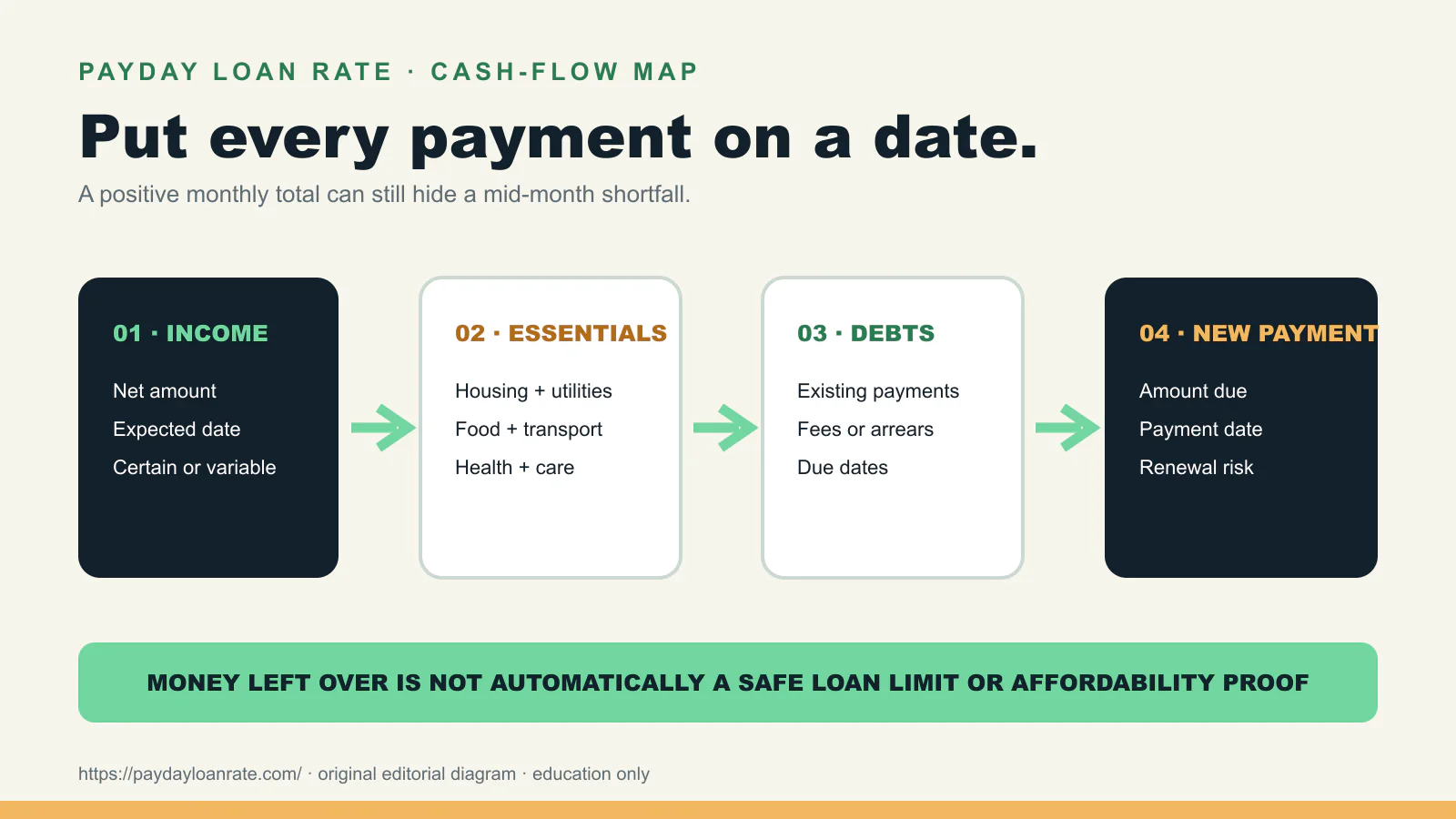
Image: Payday Loan Rate
Source check: 27 July 2026. This worksheet is educational and does not determine creditworthiness or affordability.
The CFPB’s current Your Money, Your Goals toolkit includes a cash-flow-budget tool built around the timing of income and expenses. Before considering a loan, turn the monthly view into a dated cash-flow view.
Step 1: Record income by date
Use take-home amounts that are reasonably expected, not gross salary or hoped-for overtime.
| Date expected | Source | Net amount | Certain or variable? |
|---|---|---|---|
If income changes, build both a lower and a typical scenario.
Step 2: Record essential outflows by date
Include housing, food, utilities, transport, insurance, medicine, childcare, minimum debt payments, and irregular costs due in the period.
| Due date | Expense | Amount | Can the date change? |
|---|---|---|---|
Review bank statements, bills, and receipts rather than relying only on memory.
Step 3: Add the proposed credit exactly as disclosed
Record:
- cash actually received;
- finance charge and APR;
- each payment amount and date;
- total of payments;
- late, returned-payment, renewal, or variable-rate terms;
- collateral or account-access provisions.
For payday products, the CFPB’s cost guide explains why a short term can produce a high APR.
Step 4: Recalculate each pay period
Illustrative cash-flow example—not a borrowing recommendation:
- income arriving before the next payday:
$1,500 - essential expenses and existing obligations:
$1,320 - arithmetic remainder before a new payment:
$180
That $180 is not an approved or safe loan payment. An omitted expense, variable income, emergency, or timing mismatch could eliminate it. The example only shows the subtraction.
Step 5: Stress-test the plan
Ask:
- What happens if income is late or lower?
- Which essential bill competes with the loan payment?
- Does repayment create another need to borrow?
- Can the original bill be moved or placed on a payment plan?
- Is there a lower-cost option actually available?
The CFPB’s emergency-fund guide explains how even a small reserve can help with unplanned expenses. Building one is a longer-term resilience step, not a solution to every immediate emergency.
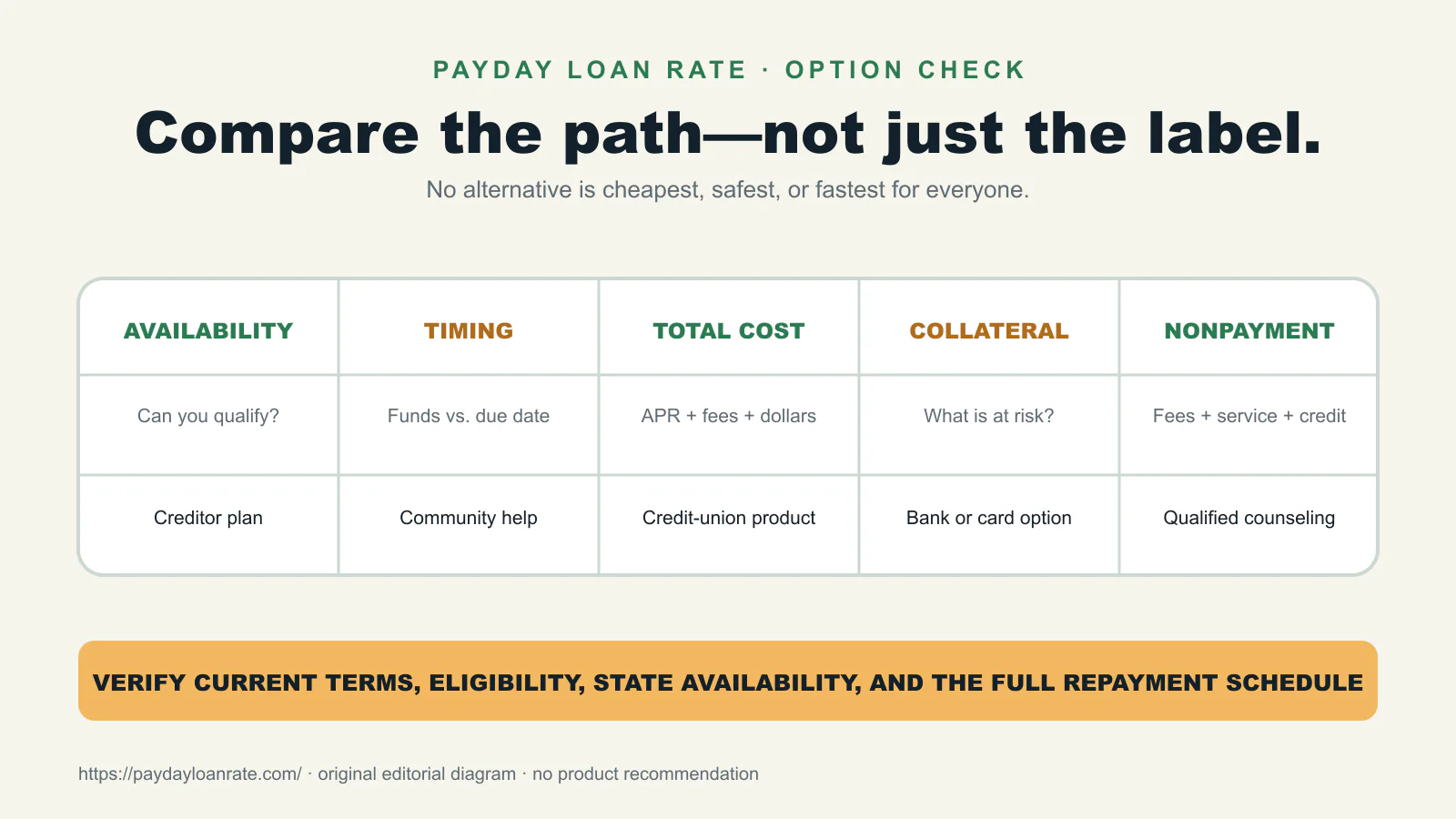
Step 6: Compare alternatives on the same sheet
Place each real option in the same format:
| Option | Cash or relief received | Total cost | Payment dates | Main consequence or risk |
|---|---|---|---|---|
| Creditor payment plan | ||||
| Credit-union or bank product | ||||
| Other documented option |
Do not write “free,” “instant,” or “guaranteed” unless the written terms support it.
Key takeaway
A dated cash-flow worksheet can expose a repayment collision. It cannot, by itself, decide whether borrowing is appropriate or create a safe borrowing ceiling.
General consumer education only, not financial, credit, debt, or legal advice.
budgetingborrowing-basicsrepaymentconsumer-educationpersonal-finance